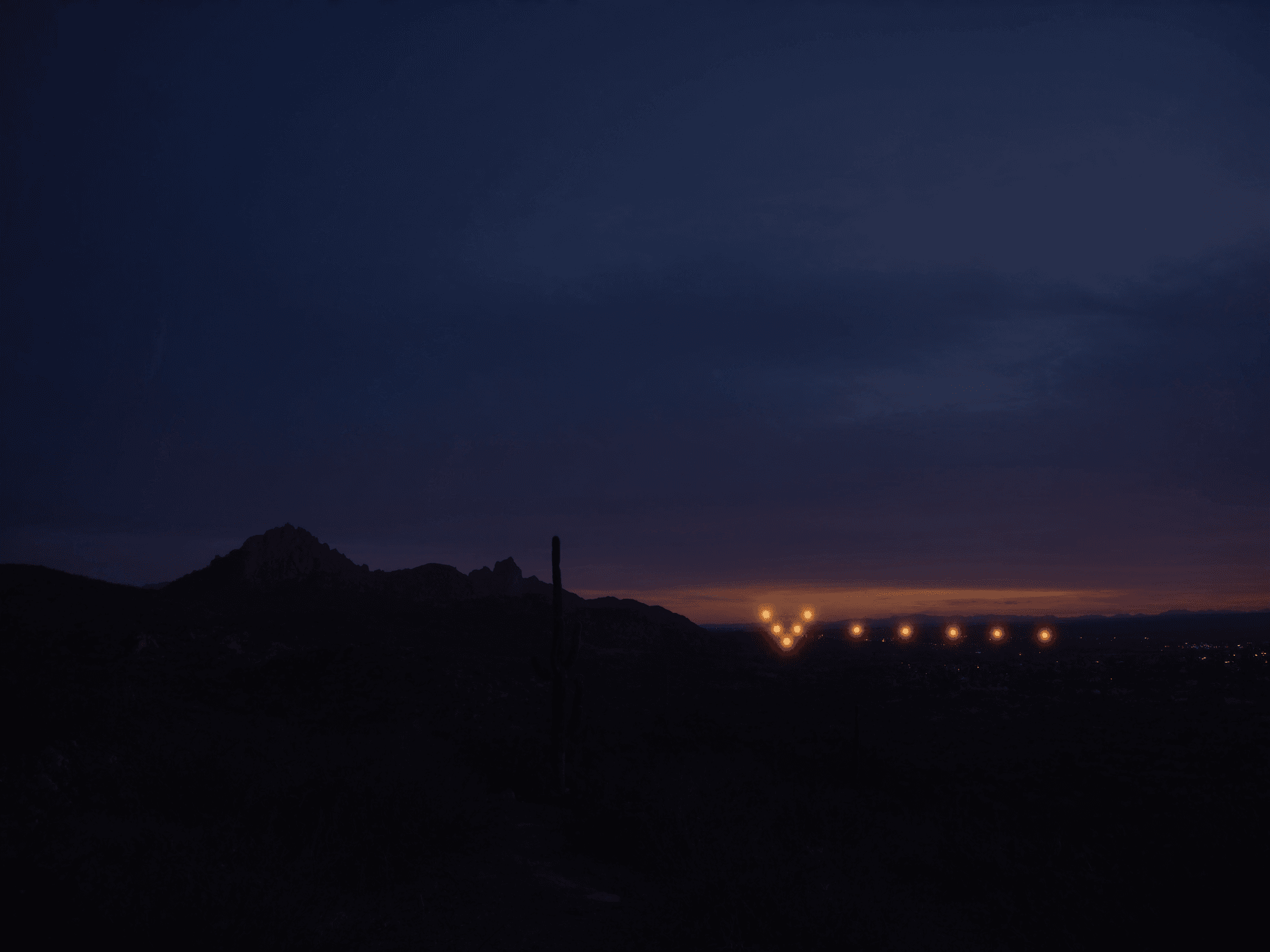
On March 13, 1997, thousands of Arizonans reported a V-shaped formation moving silently across the night sky from north to south. Twenty-five years later, the Phoenix Lights remain the most witnessed UAP event in modern history — and not because of the photos. It's the geography of who saw it that still matters.
A wave, not a flash
The reports didn't arrive all at once. They arrived in a slow southbound rolling pattern: Henderson, Nevada around 7:55 PM. Prescott, Arizona around 8:17 PM. Phoenix proper between 8:30 and 8:45. Tucson by 9:00. Hundreds of witnesses, each one calling local TV and 911, formed a corridor down Arizona's central spine as the formation moved through.
Phoenix-area dispatch logs from that night show a clear pattern: the calls track the path. The closer a witness lived to Interstate 17, the more likely they were to file. That's not random. That's geometry.
What 700+ reports actually showed
When the witness map is laid out chronologically — every reported time and location pinned together — the result isn't a cluster. It's a line. That line doesn't align with any commercial flight route in use that night. It doesn't match the trajectory of the military flares the Air Force eventually pointed at as the source. And it doesn't decay the way a hoax would — the reports come in at a steady cadence consistent with an object covering ground at roughly highway speed at low altitude.
The flare explanation, and why witness geometry doesn't fit it
The 1998 Air Force statement attributed at least part of the event to flares dropped by A-10 Warthogs from the Maryland Air National Guard over the Barry Goldwater Range. That's plausible for the slow-descending lights observed in a different cluster around 10:00 PM, hours after the initial wave. It does not explain the silent V-formation reported moving through Phoenix two hours earlier — at altitudes inconsistent with falling pyrotechnics, on a heading that doesn't match the range, and described by aerospace engineers, retired pilots, and a state governor as a solid object passing in front of stars.
Why this still matters for today's reporting
The Phoenix wave is the reason single-witness reports rarely answer anything on their own. Patterns answer questions. One person saying "I saw a triangle" is a story. Two hundred people drawing a corridor across a state is data.
That's the principle Sighted's clustering is built on. Every report within a defined radius and time window is pulled into one viewable corridor, so a wave is unmistakable when one rolls through your region. The Phoenix data took fifteen years of journalism to assemble. We want the next one to be visible in real time.
The lesson
File every report, no matter how confident you are about what you saw. The map is the answer.